I’m going on tour with my dear friend Rian again, playing in Maria BC (not as Dear Laika) for five UK dates. Their latest album, "Marathon", is wonderful, subtle and melodious. You should absolutely listen to it, and please do come to these shows if you’re able.
New Dear Laika record? Haven’t really worked much on it. Michael Bede Dunlop laid down the bass parts earlier this year and did a fantastic job of it, but as is so often the way with me, my interest in the songs quickly dispersed again when left to my own devices. It’s not an emotional or practical priority, though Work Not Yet Done does loom over me a bit. Creative collaboration is just a much more enjoyable process for me nowadays; it’s why I’m delighted to be performing in a duo with Rian again, and why I’ve gone even deeper into roleplaying games. There’s also the matter of my “high” (arbitrary) standards to which I hold my work… but that’s all about product rather than process. I want a shared process, not a lonesome one. As I’ve mentioned before, this is why RPGs have been so fulfilling for me.
My main creative enthusiasm is currently Mothership, a sci-fi horror RPG system. I’m running two ongoing games with weekly sessions, using modules written and designed by someone else. After a couple of years of doggedly DIYing all our material – characters, settings, scenarios, rules – taking something made by strangers and making it our own in real time has given us a new lease of creative life. It’s also been a joy to run games for friends who haven’t had much or any experience with RPGs and see them get the bug in real time. Mothership’s encouraged gameplay style is interaction with the diegetic elements of the world and its people, rather than with an abstract, exogenous ruleset; I care neither for the tactical wargames of Pathfinder or LANCER, nor for the rigidly mechanised story generation of Powered by the Apocalypse games and others of their ilk. In other words, it is not a board game or video game in disguise! Mothership provides a robust set of tools to help the GM build or embellish environments and situations for the players to explore, but it trusts playgroups with the ability to form a consensus about things outside of the rules, informed by real-life empirical experience and genre-savviness. “Rulings over rules” is the popular motto.
This style of play (often associated with the New School Revolution movement in RPGs) was a breath of fresh air after becoming an assistant storyteller for a Vampire the Masquerade LARP. One of my biggest frustrations with this LARP – and this is structurally inescapable – is its necessary adherence to the byzantine rules of the 2013 Mind’s Eye Theatre system and its subsequent updated volumes. The combat rules are so notoriously broken that game-runners have previously used them to incentivise the players to AVOID fighting, lest they become bored and frustrated. There are over 100 books devoted to the world-building of Vampire – though they sometimes contradict each other across and within editions – and veteran players have absorbed a lot of this lore. The smaller the group, the easier it is to form a consensus for revision of rules and game-worlds. When you have a public LARP with a player count of 40+ and multiple storytellers, you need an absolutely objective ruleset and state of the world, and one which is instantly accessible and legible to newcomers. Vampire LARPs are therefore obligated to stick to the book as much as possible to avoid confusion and disagreement among the player base. This is a problem if you think a lot of that book is crap, which I do. I resigned from my position of assistant storyteller and seriously considered quitting the game altogether, but I think I can ignore the infuriating crap and focus on the delight of immersive roleplaying with lovely people.
Anyway, here are my three favourite modules which I’ve run in Mothership thus far, along with some music that was used to soundtrack them.
An absolutely monolithic module set in Cloudbank, an abandoned android production facility ruled over by a rogue super-intelligent AI called Monarch with a terrifying ability to get inside and mess with your head. It treads similar existential ground to classic cyberpunk like Ghost in the Shell and Blade Runner, but it has elements of Stalker (both the Tarkovsky film and the video game series) in that players enter a hostile and derelict “zone” in which dark miracles are made. Often held up as a shining example of a “negadungeon” (a particularly horrific and deadly megadungeon), it is far from a simple dungeon-crawl: there are competing factions and ethically charged decisions to be made, and the facility is designed to slowly erode and mutate each character’s trust in their experience of reality.
I first played Gradient Descent as a “duet” game, in which I was the only player and my partner was the GM. Dr Ikoe Shon’s 12-year-old son was abducted by her own android crewmate and taken deep into Cloudbank. Utterly desperate, Shon was willing to negotiate with Monarch from the jump, though quickly realised that the AI had enough leverage to keep her doing its bidding as an expendable pawn without ever making good on the promise to help her. The climactic showdown with her android crewmate was particularly harrowing, as they believed whole-heartedly that they were human and vindictively tortured Shon with her darkest fears and deepest insecurities, the worst being the plausible insinuation that she was an active danger to her son, who would be safer away from her. Grimly concluding that the android had been reprogrammed into delusion and blind hatred by Monarch, Dr Shon realised it was either her or them. In the final shootout, her son cried out and ran towards their former crewmate, only to see their body burst apart, not with white android pseudomilk but with red human blood. Though mother and son both safely left Cloudbank, the sickening horror of that encounter would last the rest of their lives.
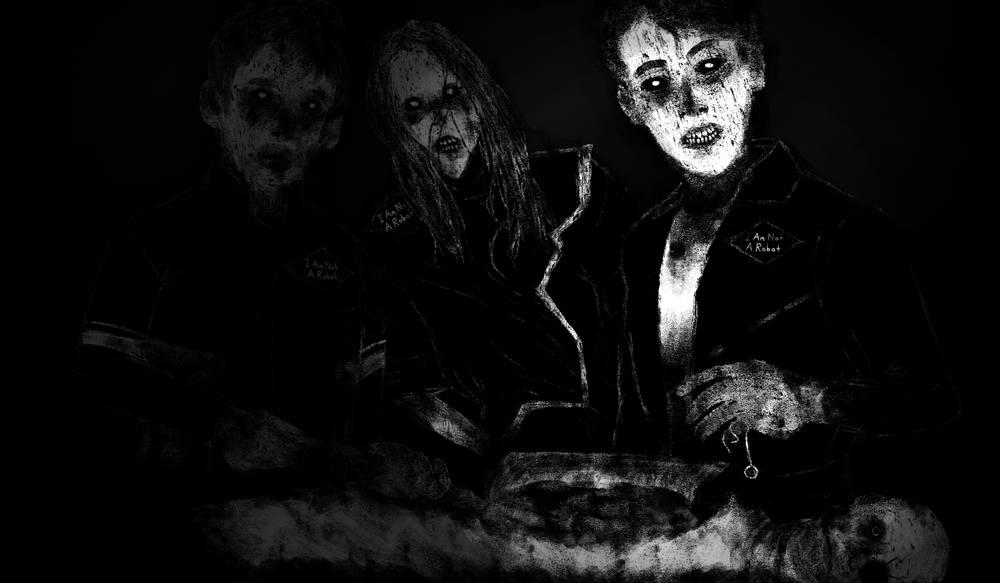
I’m now running my own Gradient Descent campaign for three players, having enjoyed being a player tremendously. So far, they’ve armed a group of broken androids trapped in the facility and been complicit in the resulting massacre, been disturbed by a religious relic that presents itself differently to each person who views it, briefly escorted but then turned against cultists who believe Monarch is the herald of panpsychist singularity, and hacked into the facility’s brain-scan storage to replace a default android mind with a brain-scanned human mind. In a module this enormous and free, players have the agency to pursue their own goals and solve (or create) their own problems, and it’s marvellous!
The perfect soundtrack for Gradient Descent is “I Am the Dirt under Your Fingernails” by Final (Justin Broadrick’s dark ambient solo project). It really evokes the pitch-black, cavernous industrial labyrinth of Cloudbank, its years of decay, and the creeping dread that Monarch might already own your soul.
Owe My Soul is a dense political sandbox set in a mining colony on Callisto. Tensions are escalating between the Regional Authority that nominally own the colony and the subcontracted Margrave Industrial Concern that operate and profit from it. Workers for the Concern are coerced into forking their consciousnesses, which are then copied into enormous synthetic “labour bodies” that are denied legal personhood and work in indentured servitude. Insurgent groups form both among the baseline humans and the labour bodies, dangerous but politically manipulable, while smugglers and black marketeers take advantage of the mounting civil unrest.
I’m running this module like a corporate espionage game. The PCs are undercover auditors sent by the Authority to gather information on the political situation, but they all have their own motivations. Violet Lehner has engaged in spirited political debates with a Marxist reading group who accuse each other of being “biological reactionaries” and “crypto-Abandonists”; Tiger Breeno has been swayed by the promise of 100k in exchange for being forked, and has taken at least three psychoactive drugs in an attempt to psychically connect with his future labour body counterpart; Mun Ji-Su is playing each side against the other, fucking and flirting with corrupt police chiefs, inciting radicals to murder cops, bribing secretaries with morphine, trying to get as much dirt on everyone as possible. It all feels in the spirit of Disco Elysium and we’re absolutely loving it!
The soundtrack to this module has mostly been dub techno and adjacent stuff: Moritz von Oswald Trio, Deadbeat, Pole, Jan Jelinek… All quietly propulsive and cool for their investigations and subterfuge. Real techno-spy tunes.
Mothership is very popular as a system for running deadly one-shot games, and my favourite so far has been Dead Weight. The PCs are blue-collar workers on a geological transport vessel shipping asteroid samples. There are no monsters to fight, but more a force of nature to grapple with: an escalating crisis that literally tears the ship apart if the crew don’t discover the cause and find a creative way to stop it. It’s a tightly designed scenario, claustrophobic and tense. Getting the players to manage the emotions and dangerous impulses of the other crewmates in the face of catastrophe adds another dimension. There’s less to say about it, by virtue of it being a smaller module, but it had my players feeling lightheaded with suspense. I think it would make a very worthy introduction to Mothership. Almost like Alien without the titular alien.
As soon as the crisis began to unfold, the soundtrack was all Autechre, mostly their 2024 live sets. Absolutely sickening, relentless tension!
Other than Mothership modules, we’re still very much keeping up DIY. We’ve been playtesting a work-in-progress system by one of our regular group members, who has used a demo to run the OSR module PRISON OF THE HATED PRETENDER by Gus L. I’m usually allergic to High Fantasy (even the invitation to play Shadowdark with its halflings and dwarves gave me an anxiety attack) but the character creation process was inviting, being mostly inspired by Demon Souls and Nausicaä of the Valley of the Wind. Rolling for stats and backgrounds and equipment and all that, I ended up with a little hornèd man who had built his own doohickey pistol that only he knew how to operate. I decided he was very book-smart about martial tactics but had limited experience in actual combat. I cracked open my copy of the 1973 Reader’s Digest tome “Folklore, Myths and Legends of Britain” and chose the name Wenlock for this little guy. He managed to scale a tree and the titular prison by tying extra rope to a boleadora, but then was so distracted by a mysterious bronze astrological contraption on the roof and how it could be transported that he neglected to steal any of the pocketable treasure. He ended the adventure mortally wounded and begging for mercy after a pathetic gun duel with the cat-faced knave PC who had secretly pledged allegiance to the titular Hated Pretender. The only PC who walked away neither dead nor enslaved to the Pretender was the outlander Rapunzel, whose main concerns were eating bugs and coveting the enormous pumpkin she found in a bathtub. When the Pretender threw poisonous snakes at her in retaliation for her eating the pumpkin, she bit the snake’s head clean off. It was heartening that I could still have lots of fun in a silly old-school fantasy game. I felt my horizons re-expanding.
We’re also approaching the end of the fully DIY game we’ve been playing for two years, a crime-drama epic set in Detroit’s Mexicantown as the city slides into bankruptcy. It’s been an enormous experimental undertaking with a massive cast of characters, including two PCs for each player, and I don’t even think a dedicated blog post could begin to do it justice. The whole thing started with three brothers unable to pay the mortgage on their house and resorting to burglary; this then escalated into multiple arsons (including a train carriage full of heroin), vigilante justice at a house party, uncovering an untouchable conspiracy between the Polish mob and a predatory property development company, desperate shootouts at cheap motels, gas stations, and hunting cabins… and finally a tragic case of fratricide that tore friendships apart.
I have had the pleasure of roleplaying two characters in their own toxic codependent relationships. The first is Viola Low, a borderline psychopathic bartender-turned-accountant who gets herself into deep shit through her confidence, stubbornness, and insane risk-taking. She became quickly entangled with a similarly adrenaline-addicted narcotics detective called Sylvia Werner, only finding out she was an undercover cop by stealing her phone and convincingly imitating her voice when her partner called. Throughout the story, the two have been enabling each other’s risky behaviours, secretly collaborating on an illegal investigation into local gang activity; it’s a juvenile power fantasy for both of them, being cool detective-spies, and it means using and abusing the trust of everyone around them. Even as they treat each other like shit, even after Sylvia got shot, sent to rehab, and then relapsed as a result of these investigations, they’re still fatally drawn to each other. It’s only now that they’re beginning to realise just how fucked things really are between them.
The second is Ely Ricci, a directionless young gas station worker and cigarette connoisseur who is hopelessly enamoured with his drug-dealing sort-of-boyfriend Blind. Sylvia was attempting to infiltrate the drug operation of Blind’s “business partner” Red Indiana, who treated Blind like a lackey, keeping him in the dark about his double-dealings with the Polish mob and the Latin Counts. After a brokered deal went bad at the aforementioned house party, Red and Blind went underground, with Blind enlisting Ely’s help to try and manoeuvre to take over Red’s operation as they dodged mob hitmen (including another PC). A year later, scarred by an illegal honeypot interrogation gone wrong in which he shot an FBI agent (another PC!) with Sylvia’s partner’s service pistol, and with Red out of the picture, Blind began to unwittingly replicate the same dynamic he had with Red but with Ely, treating him poorly, aggressively questioning his loyalty. Their relationship is now at a breaking point, with Ely harbouring a horrible secret: he knows the vigilante who fucked up the deal at the house party. Now that vigilante is the only person he can really confide in, as they both know each other’s secrets.
That barely scratches the surface, naturally. A hypothetical relationship map of characters in this story would look like the most convoluted conspiracy board. Every time I want to talk about another aspect of a character or another thing that happened, I feel like I need to provide twice as much context. Though it shouldn’t really be the goal of one creative medium to faithfully imitate the form of another – and I personally dislike RPG rulesets which manage genre narrative by incentivising players to achieve Plot Beats as part of character advancement – this is the closest an RPG experience has come to resembling prestige TV like The Sopranos or The Wire for me, and it has been a very special experience indeed.
Well, as always, I hope that someone finds this all interesting or entertaining. Just to sign off, here's some albums I've been enjoying recently (having settled comfortably into niches rather than devoting lots of time to exploration):
Car Bomb - Mordial
The Bug vs Ghost Dubs - Implosion
Yellow Eyes - Immersion Trench Reverie; Rare Field Ceiling
Aphex Twin - Syro
Hope Sandoval & The Warm Inventions - Bavarian Fruit Bread
Thantifaxath - Sacred White Noise
Andrew Hill - Point of Departure
Caterina Barbieri & Bendik Giske - At Source
Gilla Band - Pugnello
Seefeel - Sol.Hz
Volker Kriegel - Inside: Missing Link
Herbie Hancock - Mr Hands; Man-Child; pretty much all his pre-1975 albums
Laurel Halo - Atlas
Kali Malone & Leila Bordreuil - Music for Intersecting Planes
Lyle Mays - Lyle Mays
John Coltrane - Interstellar Space
My book recommendation is Sylvia Townsend Warner's "The Corner That Held Them".
My film recommendation is "Green Snake", directed by Tsui Hark.
Both are absolutely breathtaking.